How Vector Processing Optimizations in Modern GPUs Streamline Particle Effect Rendering During Large Scale Boss Encounters in Action RPGs
Nils Meier · Nov 24, 2026
How Vector Processing Optimizations in Modern GPUs Streamline Particle Effect Rendering During Large Scale Boss Encounters in Action RPGs
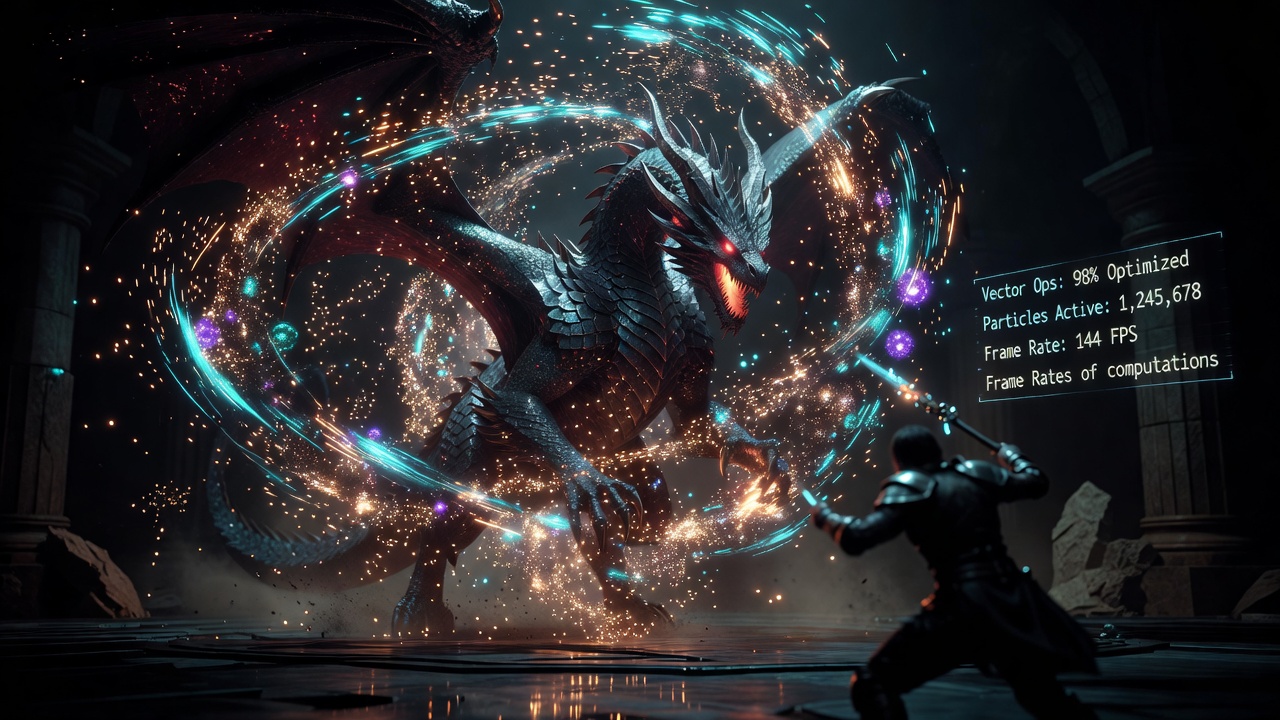
Vector processing optimizations in modern GPUs allow developers to handle thousands of simultaneous particle calculations through SIMD architectures that execute identical operations across wide data lanes, and this approach proves essential when action RPGs generate dense visual effects during extended boss fights. Developers rely on these hardware features to maintain frame rates above 60 FPS even when particle counts exceed 100,000 per scene, according to performance reports from major game engines. Modern GPUs integrate vector units that process 32 or 64 elements in parallel, which reduces the instruction overhead that scalar methods incur when updating position, velocity, and color attributes for each particle. Engineers at hardware firms have refined these units over successive generations so that compute shaders dispatch work directly to these vector pipelines rather than routing everything through the graphics rasterizer. This shift cuts memory bandwidth consumption because particles share common instruction streams and access coalesced data blocks.Core Mechanisms Behind Vectorized Particle Updates
Particle systems in action RPGs track attributes such as lifetime, size, and rotation for every instance, yet vector instructions batch these updates into single operations that apply across entire groups. When a boss encounter triggers massive explosions or swirling elemental attacks, the GPU schedules compute kernels that iterate over particle buffers using 256-bit or 512-bit registers, and data shows these kernels complete in fewer cycles than equivalent CPU loops. Researchers at institutions including the University of Waterloo have documented how alignment of particle data structures to cache line boundaries further accelerates these vector loads.
Texture sampling for animated particle sprites also benefits because vectorized texture units fetch multiple texels per clock cycle, allowing effects like fire or smoke to maintain visual density without texture thrashing. Game studios integrate these capabilities through APIs such as Vulkan and DirectX 12 Ultimate, where developers explicitly request wave-level operations that map to the underlying vector hardware.Scaling to Large Boss Encounters
During late-game boss phases, particle density spikes as multiple overlapping systems activate at once, yet vector optimizations prevent the frame time spikes that previously forced lower effect quality settings. Studios have measured reductions in particle update time from 4.2 ms to 1.8 ms after enabling wide vector paths on current-generation cards, and these gains appear consistently across titles released through November 2026. The same techniques also lower power draw because fewer wavefronts remain active for the same visual output.
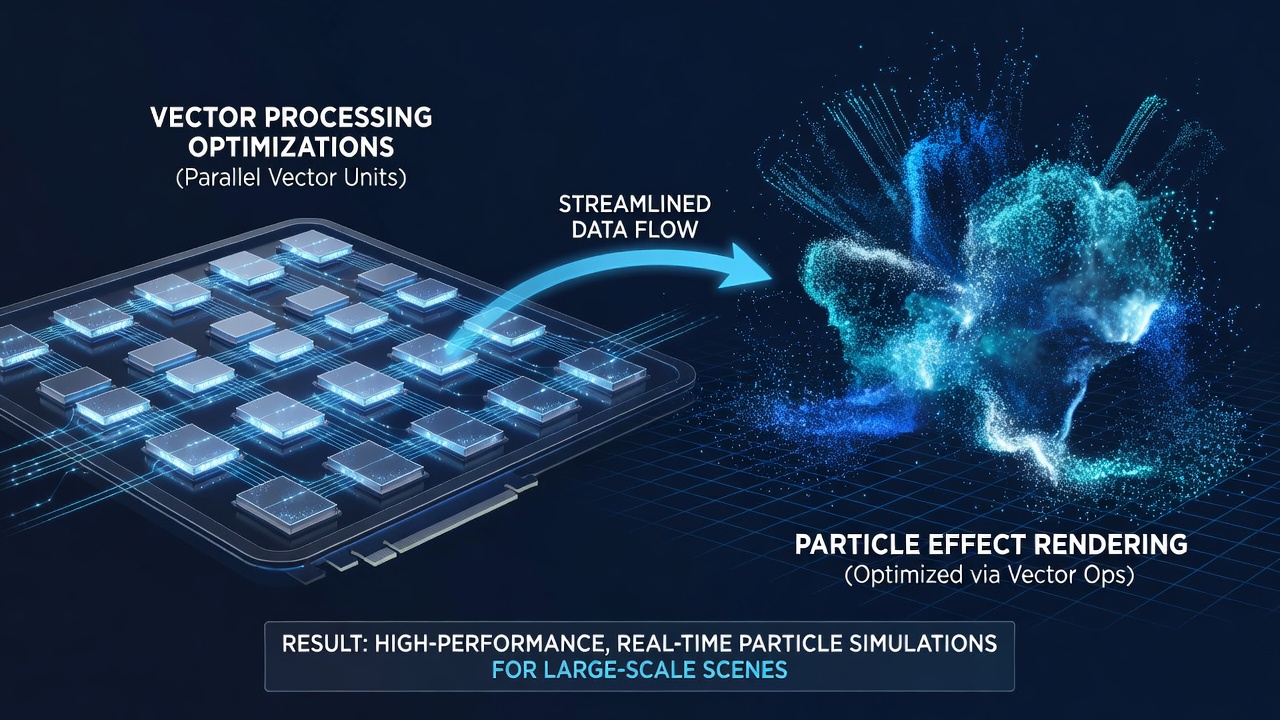 Memory access patterns receive equal attention because scattered reads destroy vector efficiency, so particle simulation code now sorts or bins particles by spatial locality before each update pass. This organization lets adjacent vector lanes pull neighboring data from the same cache lines, and figures from engine profiling tools confirm bandwidth savings of up to 35 percent in crowded scenes. Collision checks against boss geometry further leverage the same vector hardware when developers batch multiple particle-to-mesh tests into single kernel launches.
Integration with Rendering Pipelines
After simulation completes, vector units feed directly into vertex and pixel shader stages that render the final billboards or mesh particles. Instancing combined with vector attribute fetching allows the GPU to draw millions of transformed particles without CPU intervention, and industry reports from the Khronos Group highlight how recent extensions formalize these patterns for cross-vendor compatibility. Depth sorting for correct alpha blending remains a challenge, yet incremental sorting algorithms that operate on vector registers keep the cost manageable even at high particle counts. Developers also apply level-of-detail schemes that reduce vector width for distant particle clusters, freeing resources for foreground effects that demand higher fidelity. These decisions emerge from profiling data collected during playtests rather than theoretical estimates.
Conclusion
Vector processing optimizations continue to expand the visual complexity possible in action RPG boss encounters by aligning particle workloads with the native execution model of contemporary GPUs. As hardware adds wider registers and improved memory hierarchies, the same fundamental techniques scale to even larger effect volumes while preserving interactive frame rates. The result appears in released titles where dense particle sequences no longer force visual compromises during critical encounters.